

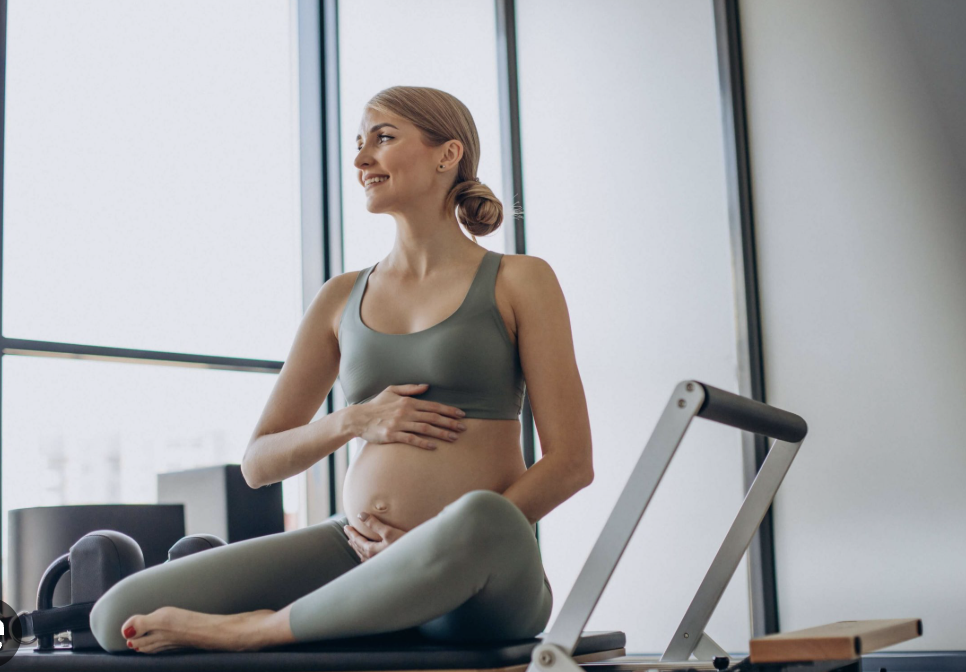
Pregnancy doesn't mean a woman has to stop moving.
For many women, staying active during pregnancy can be an important part of maintaining strength, mobility, balance and overall well-being. Pilates can be especially appealing because it emphasizes controlled movement, posture, breathing, stability and body awareness.
But teaching Pilates to a pregnant client isn't simply a matter of taking a regular Pilates class and removing a few exercises.
Pregnancy changes the body—and your approach as an instructor needs to change with it.
Your job isn't to push a pregnant client to perform the way she did before pregnancy. Your job is to help her move safely and confidently through the changes her body is experiencing.
First: Pregnancy Is Not a Medical Condition You Need to "Fix"
It's important to begin with the right mindset.
A healthy pregnancy doesn't automatically mean a woman needs to stop exercising. However, every pregnancy is different, and there can be medical circumstances in which exercise needs to be modified or avoided.
That's why instructors should encourage pregnant clients to discuss their exercise program with their healthcare provider, particularly if they are beginning a new program, have complications, or have been given specific exercise restrictions.
And remember: you are the fitness professional, not the medical professional.
Don't diagnose. Don't interpret pregnancy-related symptoms. Don't assume that something is safe simply because another pregnant client was able to do it.
When in doubt, refer the client back to her healthcare provider.
Pregnancy Changes the Way the Body Moves
One of the biggest mistakes an instructor can make is thinking of pregnancy as a single nine-month period.
The body is continually changing.
Balance changes. The center of gravity changes. The abdomen changes. The pelvis and rib cage change. Breathing mechanics can change. Joints and connective tissues are affected by hormonal changes. Fatigue can vary dramatically from one day to the next.
And what feels comfortable during the first trimester may not feel comfortable several months later.
This means your instruction needs to be responsive rather than rigid.
Instead of asking:
"Can she still do this exercise?"
ask:
"Does this exercise still make sense for her body today?"
That's a much better question.
Don't Treat the Pregnant Client Like a Regular Client
One of the most important skills for an instructor is learning to modify without making the client feel as though she is being singled out.
Your goal isn't to create a "lesser" workout.
It's to create an appropriate workout.
For example, a client may need:
Less range of motion
A wider or more stable base of support
Additional support from a wall, chair or other appropriate equipment
A different body position
Reduced resistance
Fewer repetitions
More rest
More time to transition between positions
A lower-intensity version of an exercise
These aren't signs that your client isn't working hard enough.
They're signs that you're paying attention.
Be Particularly Thoughtful About Positioning
As pregnancy progresses, certain positions may become uncomfortable or inappropriate for an individual client.
Supine exercises—the client lying flat on her back—are one area instructors should approach thoughtfully, particularly later in pregnancy.
Rather than automatically keeping a client in a position simply because it appears on your class plan, observe how she feels and use appropriate modifications.
Side-lying, seated, standing, quadruped and supported positions may provide useful alternatives depending on the exercise, the stage of pregnancy and the individual's circumstances.
The lesson for instructors is simple:
Don't become attached to the choreography.
The exercise is the tool.
The client's well-being is the priority.
Pay Attention to the Core
Pilates instructors naturally spend a great deal of time talking about the core.
Pregnancy requires us to rethink how we communicate about it.
The goal isn't to tell a pregnant woman to "pull your abs in harder" or aggressively brace her abdominal wall.
Instead, focus on functional core support, breathing, posture, alignment and coordination with the pelvic floor.
Avoid creating unnecessary pressure or encouraging clients to hold their breath.
Useful cues might include:
"Breathe naturally as you move."
"Stay tall through your spine."
"Think about gently supporting your center."
"Move with control rather than forcing the range."
The emphasis shifts from maximum abdominal effort to efficient, coordinated movement.
Don't Forget the Pelvic Floor
The pelvic floor deserves attention during pregnancy, but instructors should be careful not to reduce pelvic-floor training to "squeeze harder."
The pelvic floor needs to coordinate with breathing, abdominal pressure and movement. It also needs the ability to relax.
Rather than constantly cueing a strong contraction, help clients develop awareness of breathing and whole-body coordination.
And if a client reports pelvic pain, pressure, leaking, heaviness or other pelvic-floor concerns, that's an excellent reason to encourage consultation with a qualified healthcare professional, such as a pelvic-health physical therapist.
More squeezing isn't always the answer.
Intensity Matters More Than Performance
Pregnancy isn't the time to chase personal records.
A client's workout may look completely different from her pre-pregnancy Pilates practice, and that's okay.
Encourage her to use perceived exertion and how she feels as guides rather than focusing exclusively on numbers, repetitions or achieving a particular range of motion.
A pregnant client should be able to recognize when she needs to reduce the intensity, take a break or modify an exercise.
And don't create an environment where stopping is interpreted as failure.
You might say:
"We're going to work at a level that feels appropriate for your body today."
That gives the client permission to listen to herself.
Transitions Matter Too
Here's something instructors sometimes overlook: getting into and out of an exercise can be just as important as the exercise itself.
As pregnancy progresses, getting from the floor to standing may become more difficult.
Don't rush your client through transitions.
Give her time.
Provide stability when appropriate.
Consider how she can comfortably move from one position to another rather than simply calling out the next exercise.
A well-designed prenatal Pilates session should feel intentional from beginning to end—not like a standard class with pregnancy modifications added at the last minute.
Watch for Red Flags
Instructors should know when it's time to stop exercising and refer a client for medical evaluation.
Pregnant clients should be advised to stop exercising and seek appropriate medical guidance if they experience concerning symptoms such as vaginal bleeding, significant fluid leakage, chest pain, fainting or severe dizziness, significant difficulty breathing, painful regular contractions, or other unusual or concerning symptoms.
You don't need to determine what's causing the symptom.
You need to recognize that it shouldn't be ignored.
When something doesn't feel right, err on the side of caution.
Every Trimester Can Look Different
First Trimester
Some women feel relatively normal. Others experience significant fatigue, nausea or changes in energy.
Don't assume that a client who exercised intensely before pregnancy will automatically want to maintain that intensity.
Listen.
Modify when necessary.
Second Trimester
As the abdomen grows, balance and comfort may begin to change more noticeably.
This is a good time to reassess positioning, stability, range of motion and exercise selection rather than waiting until something becomes uncomfortable.
Third Trimester
The focus often shifts even more toward comfort, stability, mobility, breathing, functional strength and preparing the body for the physical demands ahead.
Exercises may need additional support and more frequent modifications.
The important point is that there is no single "pregnancy Pilates routine."
There is only an appropriate program for the individual woman in front of you.
The Best Prenatal Pilates Cue? "How Does That Feel?"
One of the most powerful tools you have as an instructor is communication.
Ask questions.
"How does that feel?"
"Is that comfortable?"
"Do you feel stable here?"
"Would you like to try another position?"
And actually listen to the answers.
Your client is the expert on what she is experiencing in her body.
You bring the exercise knowledge.
She brings the lived experience of her pregnancy.
Together, those two pieces can create a much better workout.
Don't Make Pregnancy About What She Can't Do
Perhaps the most important lesson is psychological.
A pregnant woman may already be hearing plenty of messages about what she shouldn't do.
Your class can be a place where she discovers what she can do.
She can strengthen.
She can move.
She can breathe.
She can work on balance.
She can improve body awareness.
She can maintain a connection with movement.
She can adapt.
And she can feel strong without having to prove anything.
That's the beauty of good instruction.
Your Role as an Instructor
Teaching Pilates during pregnancy requires more than knowing a list of exercises to avoid.
It requires observation.
Communication.
Adaptability.
Good judgment.
And an understanding that the goal isn't to make pregnancy fit into your Pilates class.
The goal is to make your Pilates instruction fit the pregnant client.
When you learn to modify intelligently, respect individual differences, communicate clearly and recognize when a client needs medical guidance, you can create a class experience that feels empowering rather than restrictive.
Pregnancy is a tremendous physical transition.
Your job isn't to stop that transition.
Your job is to help your client move through it with confidence, awareness and respect for her changing body.